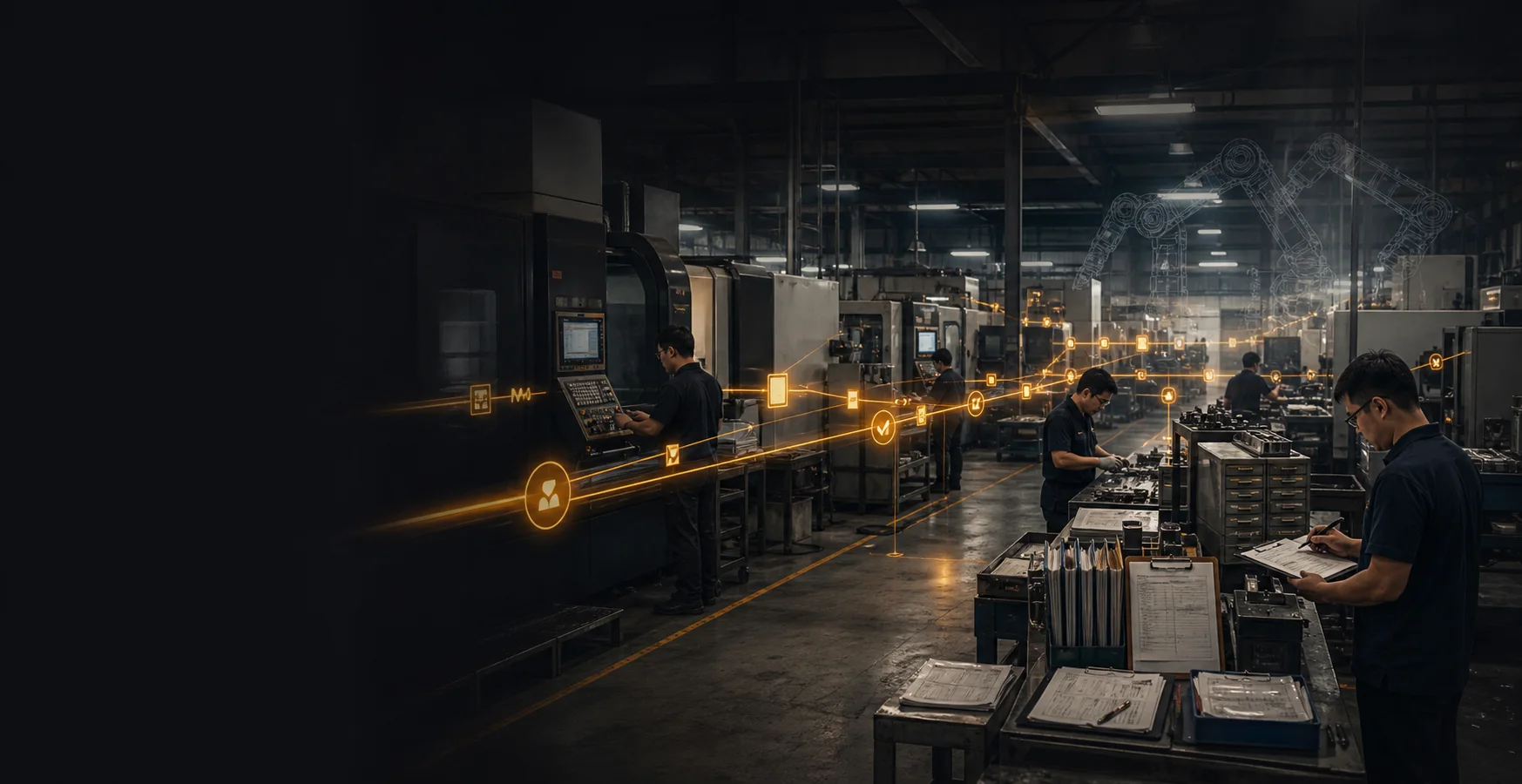
Layer 02 / Governed factory execution
The operating layerbefore factory robotics.
Structure human work before automating it. FactoryBridge OS turns approved SOPs, roles and rules into governed digital workflows that people can use now—and machines can connect to later.
Pre-MVPValidating in TaiwanBuilt for Abu Dhabi + MENA
- 01TODAY
Human work
Paper, forms, spreadsheets and experienced operators.
- 02OPERATING LAYER
Governed execution
Tasks, evidence, approval, escalation and audit.
- 03LATER
Machine action
ERP, sensors, AI agents and robots connect safely.
Layer 01 / Today
The factory already works. Its operating knowledge is simply not machine-readable.
Critical production exceptions still move through paper forms, spreadsheets, messaging apps and individual memory. Work loses clear ownership, required evidence, escalation rules and accountable closure.
The first principle
Do not automate ambiguity. Structure it first.
Unstructured today
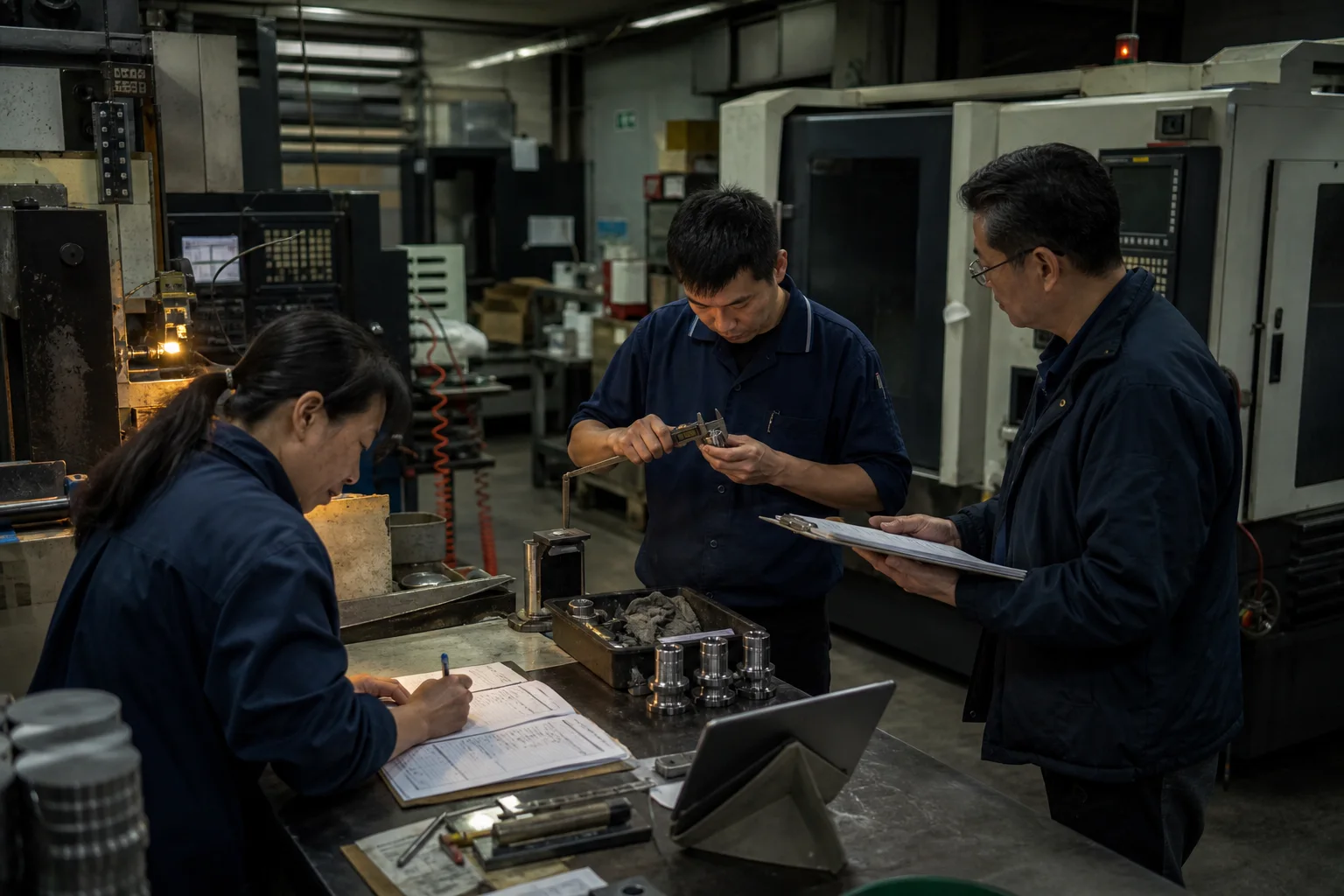
Coordination by memory
- Untracked hand-offs
- Updates scattered across paper, Excel and chat
- Tacit operating rules
- Delayed escalation
- No shared audit trail
Governed next
Coordination by rules
- Clear ownership
- Structured tasks and evidence
- Human approval gates
- Deterministic escalation
- Robot-ready task definitions
The sequencing thesis
Digitise now.
Integrate next.
Automate later.
Robots should inherit approved operating context—not guess their way through fragmented factory knowledge.
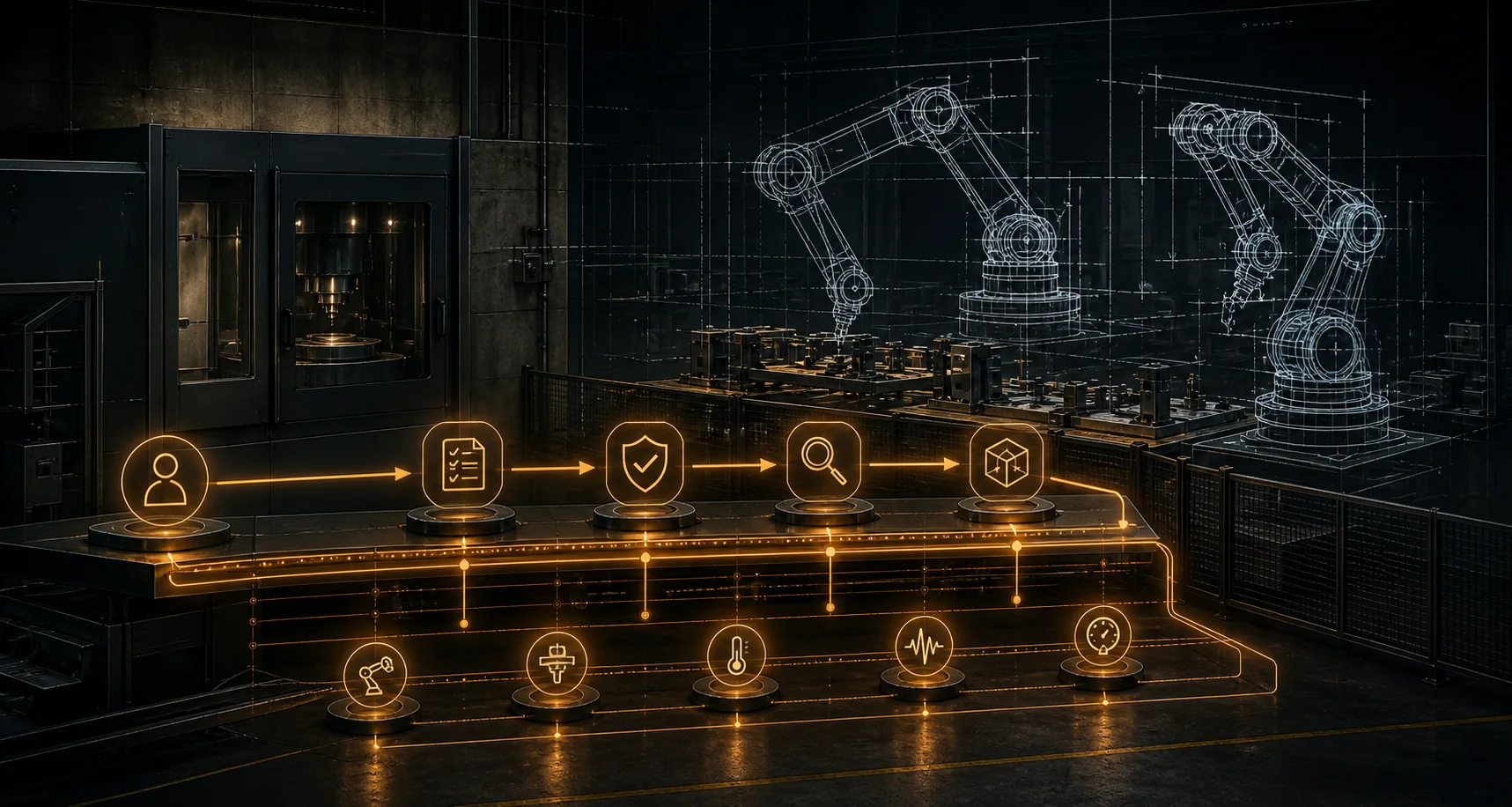
- Layer 01NOW
Govern human work
Tasks, ownership, evidence, approvals, escalation and audit trails.
- Layer 02NEXT
Connect factory systems
ERP, MES, sensors, IoT, CCTV and edge systems.
- Layer 03LATER
Enable governed autonomy
AI agents and robots receive approved tasks, structured context, safety boundaries and human escalation paths.
Core Technology
Three technologies that turn factory context into robot-ready operations.
Pre-MVP technology architecture
The moat is not a single AI model. It is the verified spatial and operating context that allows each factory to digitise once and connect new intelligence over time.
- 01Model the factory
Spatial Operating Graph
A reusable, machine-readable model of zones, assets, people, states, relationships, affordances, tasks and safety rules.
Commercial advantage
Creates a portable factory model and a proprietary operational data layer that becomes richer with every deployment.
- Zones + assets
- States + relations
- Rules + tasks
- 02Ground the real world
Multi-View Spatial Perception
Existing cameras, mobile capture and IoT signals locate equipment, work and exceptions across viewpoints and over time.
Commercial advantage
Works with brownfield infrastructure to shorten event discovery and resolution without requiring robots first.
- Camera + mobile
- IoT events
- Persistent state
- 03Govern every action
Governed Task-to-Action Runtime
Approved SOPs become executable tasks with evidence requirements, human approval gates, safety boundaries and action adapters.
Commercial advantage
Lets people execute now, AI agents assist next and robots connect later without rebuilding the operating logic.
- Human approval
- Safety boundaries
- Robot-ready API
TODAY
People execute
Mobile tasks + evidence
NEXT
AI agents assist
Perception + recommendations
LATER
Robots connect
Approved actions + boundaries
The Product
One approved SOP becomes one working exception workflow.
FactoryBridge OS converts approved SOPs, forms, roles, deadlines, evidence requirements, approval rules and escalation policies into accountable digital workflows. It sits above existing systems as a cross-team task, exception, approval and audit layer.
First use case — production exception-to-resolution
- Report
- Assign
- Investigate
- Escalate
- Approve
- Close
- Audit
Each approved workflow generates mobile forms, accountable tasks, notifications, approvals, escalations, dashboards and a complete audit trail.
Worked example — quality exception on a machining line
- 1Report
An operator on line 3 raises a dimensional deviation against lot A-2214, with a photo attached.
- 2Assign
The shift lead assigns a quality engineer as accountable owner; a four-hour clock starts.
- 3Investigate
Evidence required by the SOP is collected — measurement record, containment photo, affected quantity — and the lot is held.
- 4Approve
The QA manager approves rework. Without that approval the task cannot advance.
- 5Close
Closure criteria are met and the record is timestamped, locked and audit-ready.
How It Works
From SOP to governed operations.
MVP Product Flow — Product Concept
Illustrative workflow and sample data — not customer results.
- new workflow
Drop approved SOP
PDF · DOCX · XLSX
QA-SOP-014_Quality_Hold.pdf1.2 MBNCR_Form_rev3.xlsx84 KB01Upload an approved SOP and current form.
- extraction reviewAI proposed12 itemsStepContain affected lotLine QCRoleQuality EngineerownerEvidencePhoto + measurementrequiredDeadline4 h from reportSLA02
AI extracts steps, roles, evidence and deadlines.
- workflow editor1Report exceptionOperator2Assign ownerShift lead3Approve dispositionQA ManagerApprove workflowEdit03
A process owner reviews and approves the workflow.
- exception dashboard
Open
7
Overdue
2
Closed 7d
31
Closure time by week
04The factory runs tasks, escalation and closure tracking.
AI proposes. Rules govern. People approve.
Why It Scales
A product—not another transformation project.
Not consulting
The output is not a roadmap. It is a working workflow with accountable users.
Not custom SI
Every factory uses one core product. Customer differences are handled through reusable configuration rather than rebuilding the system.
Not a new MES
FactoryBridge OS works as the cross-team exception and task layer above existing tools, with ERP, MES, IoT and sensor connections added when required.
Hypothesis under validation
Our key product hypothesis is that each new factory should require less custom engineering, less deployment time and more reusable configuration than the previous one.
Measured as deployment hours and reusable configuration per site.
Initial Customer
Start narrow: exception-to-resolution.
Initial customer profile
20–500 employee discrete manufacturers where production, quality and equipment teams still coordinate critical work through paper, spreadsheets and messaging apps.
Initial industries
- Machinery manufacturing
- Electrical equipment
- Transport-related manufacturing
First measurable outcome
Reduce the time from exception report to accountable closure.
Metrics to validate
- Workflow adoption
- Exception closure time
- Overdue tasks
- Rework
- Deployment hours
- Percentage of reusable configuration
Current Status
Early validation, stated honestly.
FactoryBridge OS is at the Pre-MVP stage. We are seeking manufacturing design partners willing to validate one production exception workflow, establish a measurable baseline and evaluate a repeatable pilot.
Current assets
What exists today
- Defined problem and initial ICP
- Exception-to-resolution product wedge
- Product architecture
- Standard pilot structure
- Five potential Taiwan discovery sites — validation leads, not customers
Next evidence milestones
What we intend to prove
- Clickable MVP
- Two validated factory workflows
- One paid pilot
- One live workflow
- Measured buyer outcome
- Cross-site configuration reuse
Market Strategy
Validate in Taiwan. Localise in Abu Dhabi. Scale across MENA.
Taiwan offers a dense manufacturing environment for validating traditional-factory workflows; Abu Dhabi offers an Industry 4.0 pathway and a strategic base for regional expansion. We will prove one repeatable workflow in Taiwan, localise security and procurement requirements in Abu Dhabi, and build a regional manufacturing software company—not a temporary accelerator presence.
Proposed 90-day Abu Dhabi plan
- Days 1–30
Conduct 12 structured interviews with manufacturers, industrial technology providers, buyers and ecosystem organisations.
- Days 31–60
Build a localised MVP configuration, document UAE security and data requirements, and produce two design proposals.
- Days 61–90
Submit three paid-pilot proposals and target one signed pilot with a named budget owner and implementation date.
Founder
Built by a founder who can stay from discovery through deployment.

James Chen
Sole Founder & CEO / Product Lead
Education
M.S. in Computer Science
National Ilan University, Taiwan
James has nearly a decade of experience delivering large-scale AI, data, IoT, computer-vision and enterprise systems across industry and research projects—spanning requirements discovery, system architecture, full-stack development, AI integration, cloud deployment, user acceptance and operational implementation.
Founder delivery evidence from prior roles
Prior work by the founder; not FactoryBridge OS customer traction.
Manufacturing document workflows in production
Delivered quotation automation, OCR order filing and real-time inventory management for switchboard and control-panel engineering clients, where preparing a single quotation had taken 20 to 60 minutes by hand.
Multi-site service, still in daily operation
Built a LINE-based accessible transport notification service that continues to run across five Taiwanese counties: Changhua, Yunlin, Taipei, Chiayi and Nantou.
Data platforms at industrial scale
Engineered an intelligent transport data platform processing approximately 500 million records per month, including 200 million vehicle records for a live traffic service.
Independence
FactoryBridge OS is being established as a separate startup. Its product, repositories, data, contracts and intellectual property will remain separate from the founder’s current employers and consulting activities.
Contact
Is your factory ready for AI—but still running exceptions through Excel and chat?
We are speaking with manufacturing leaders, design partners and industrial ecosystem organisations in Taiwan, Abu Dhabi and MENA.
- Connect with James Chen
- Response time
- We reply to every serious enquiry within two working days.